Swimming and bathing water
Lahinch beach is used for swimming all year. The EPA rated Lahinch bathing water “Good” for 2025, down from “Excellent” the year before, and the beach did not keep its Blue Flag for 2026. Bathing restrictions have been put in place at times in recent years. We want the water quality that brings back the Blue Flag, and treatment designed with bathing water in mind.
- Established: 2025 EPA rating; loss of Blue Flag for 2026.
- To investigate: sources of bacteria affecting bathing water and how the new scheme, including overflows and the outfall, will affect them.
Sources: EPA, Bathing Water Quality in Ireland 2025; Clare FM, 13 May 2026; An Taisce Blue Flag recipients 2026; live notices at beaches.ie.
Surfing and watersports
Lahinch is one of Ireland’s best-known surf beaches. Surfers, surf schools, sea swimmers, paddleboarders and families use the bay throughout the year. Water users are in close contact with the water and need confidence in its quality.
Marine mammals
Grey seals (Halichoerus grypus) and harbour seals (Phoca vitulina) use Liscannor Bay. A 2025 survey, recorded with the National Biodiversity Data Centre, logged 116 seal records of both species across six drone and binocular surveys at Bar Trá and Coolrone. Uisce Éireann’s Natura Impact Statement for its marine surveys states that there are no established haul-out sites in the bay. We think the 2025 records deserve full analysis before that conclusion is relied on.
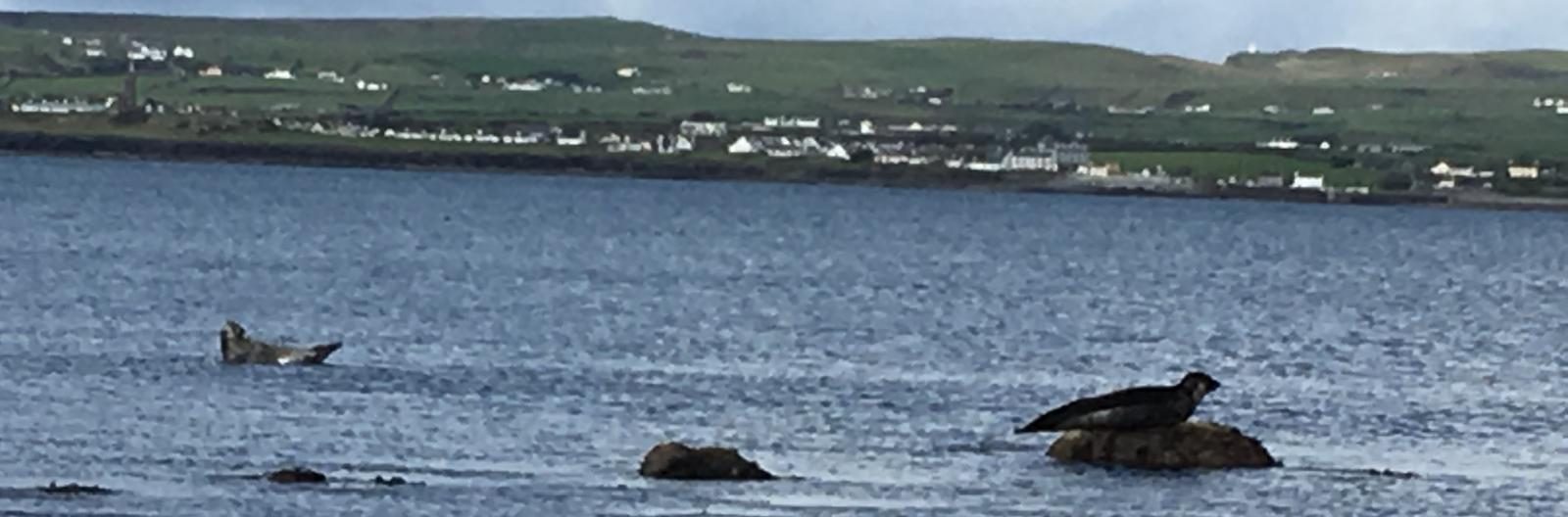
- Recorded: 2025 seal survey, National Biodiversity Data Centre Dataset 441 (Survey 1820).
- To investigate: haul-out, resting and feeding areas, and otter (Lutra lutra) use of the shore near the outfall route.
Sources: National Biodiversity Data Centre, Dataset 441; AQUAFACT for Uisce Éireann, SISAA and NIS, MUL260006 (January 2026, updated August 2026).
Honeycomb worm reef at Cregg
Local people have observed honeycomb worm reef at Cregg Beach. The honeycomb worm (Sabellaria alveolata) builds reefs of sand tubes on the lower shore, which give shelter to other marine life. CCLWAG has agreed to commission a marine ecologist to survey and map the reef, to establish its extent and condition.
- Local observation: reef present at Cregg.
- To investigate: extent and condition, through expert survey (commissioned October 2026).
Seaweed and shore habitats
The rocky shores around the bay support seaweeds, kelp and intertidal communities of shellfish, crabs and fish. These are the base of the food web that supports birds, seals and fisheries.
Birdlife
The estuary and coast support wildfowl and waders. The Inagh River Estuary, a Special Area of Conservation where the river reaches the bay, has been partly managed as a Wildfowl Sanctuary since 1989. Species recorded there include wigeon, teal, mallard, oystercatcher, ringed plover, lapwing and curlew. On the cliffs at the northern edge of the bay, the Cliffs of Moher Special Protection Area is protected for its seabirds (fulmar, kittiwake, guillemot, razorbill and puffin) and for chough (Pyrrhocorax pyrrhocorax), which feed on the grassland above the cliffs.
Sources: NPWS, Site Synopsis, Inagh River Estuary SAC (site code 000036); Cliffs of Moher SPA (site code 004005), Special Conservation Interests as listed in the MUL260006 Natura Impact Statement.
Fish and fisheries
Salmon, eel and lamprey move between rivers and the sea. Inland Fisheries Ireland told MARA that sea and river lamprey and salmon are protected under the Habitats Directive, that the European eel is critically endangered, and that “these species should be screened in and considered in any mitigation measures” for the marine surveys in the bay. Clean water matters for local fishing and for these species.
Sources: Inland Fisheries Ireland, observation on MUL260006, 26 March 2026 (MARA case page).
Tourism, livelihoods and heritage
Lahinch’s beach, surf, golf and hospitality businesses depend on a clean bay. The Cliffs of Moher, on the northern side of Liscannor Bay, are part of the Burren and Cliffs of Moher UNESCO Global Geopark, designated on 17 November 2015. Farming, fishing and built heritage are part of the landscape the scheme will pass through.
Sources: Burren and Cliffs of Moher Geopark, news release on UNESCO designation (November 2015).