Right Plant. Right Process. Right Place.Restore Our Blue Flag. Protect Liscannor Bay.
Right Process
The best engineering and open decisions.
The best engineering and open decisions. The treatment process decides what reaches Liscannor Bay. We want the most suitable technology, chosen openly and checked independently.
What the treatment levels mean
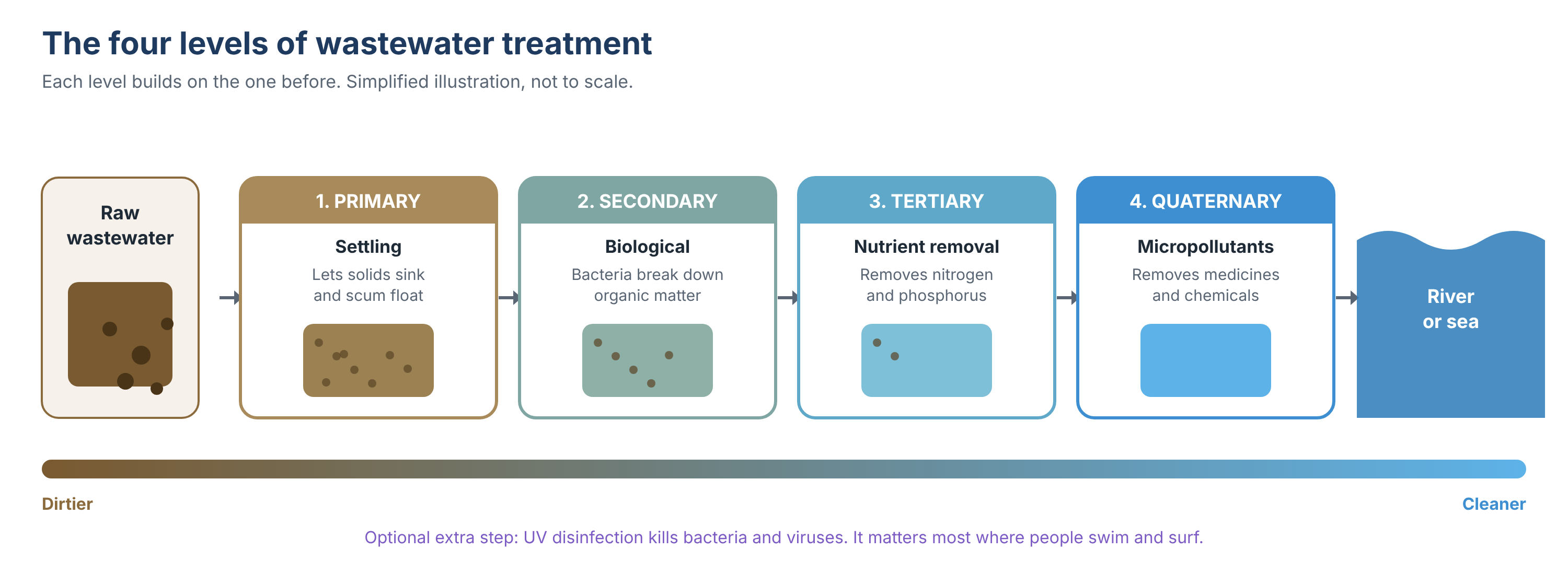
Uisce Éireann has not yet said what level of treatment the new plant will provide. That decision shapes what reaches Liscannor Bay. EU law sets out four levels of treatment, each building on the one before, and UV disinfection is often added where water is used for swimming.
Level
What it removes
How
Everyday comparison
1. Primary
Solids that sink, and fats and oils that float
Settling in a still tank
Letting muddy water stand in a bucket
2. Secondary
Dissolved organic pollution
Bacteria feed on it, with air pumped in
A compost heap, in water
3. Tertiary
Nutrients: nitrogen and phosphorus
Further biological and chemical steps, often filtration
Taking the fertiliser out
4. Quaternary
Micropollutants: medicines and chemicals
For example activated carbon or ozone
A very fine filter
Extra: UV
Bacteria and viruses
Ultraviolet light
Sterilising
The levels in detail
Select a level to see its diagram and explanation.
Level 1: Primary treatment
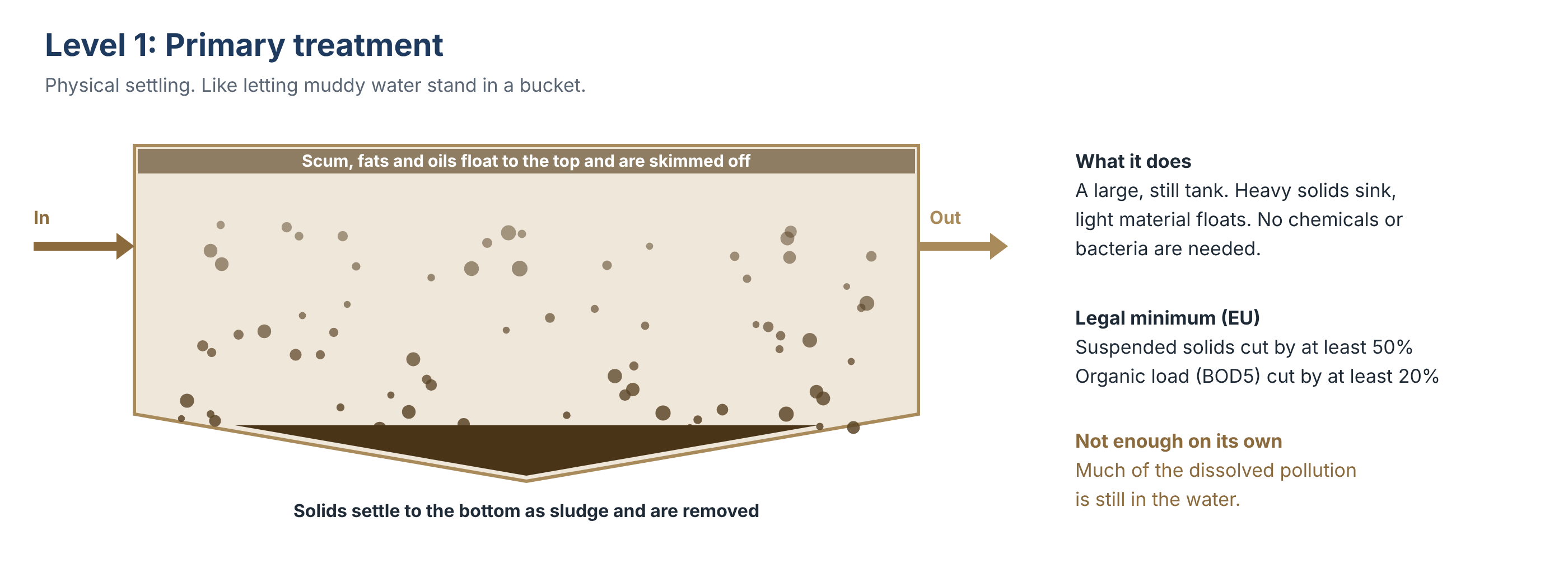
Wastewater flows slowly through a large tank. Heavier solids sink to the bottom as sludge, and fats, oils and grease float to the top to be skimmed off. Nothing is added: it is a purely physical process. EU law requires it to cut suspended solids by at least 50% and organic pollution (BOD5) by at least 20%.
In short: primary treatment removes what you can see. Much of the dissolved pollution remains, so it is never enough on its own for towns the size of Lahinch and Ennistymon.
Sources: Directive (EU) 2024/3019, Article 2(11).
Level 2: Secondary treatment
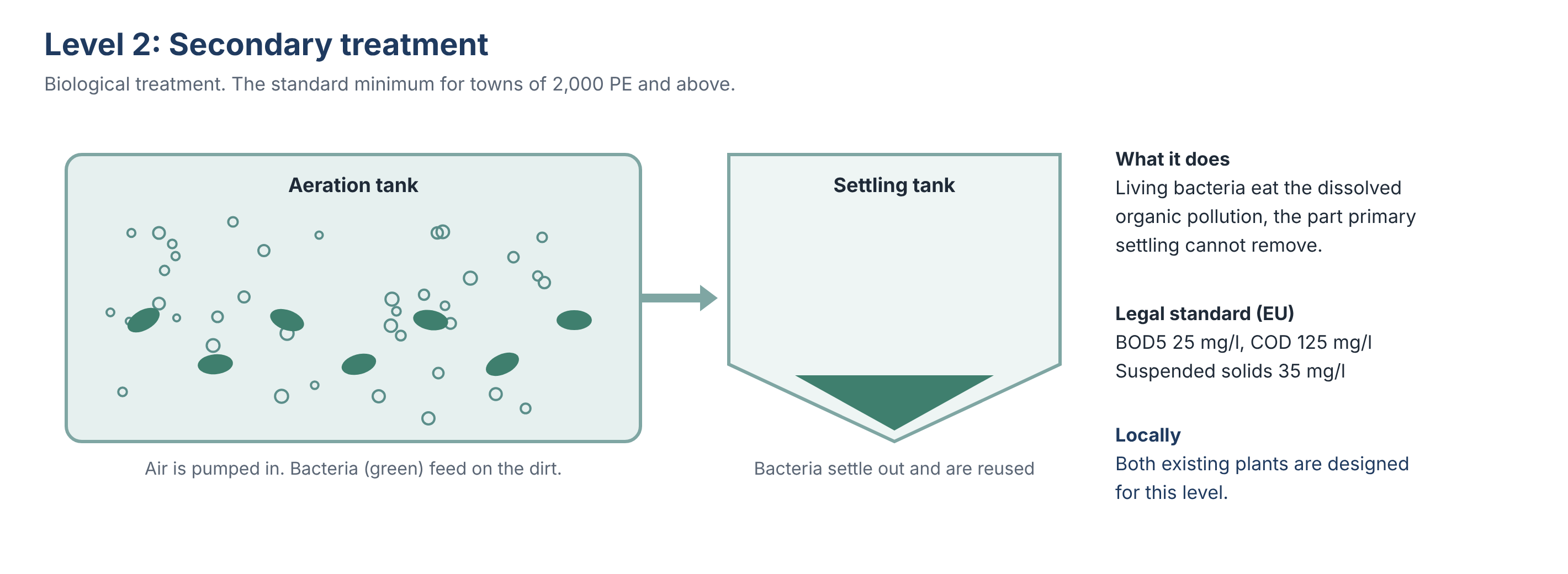
Air is pumped into a tank where living bacteria feed on the dissolved organic matter left after primary treatment. The water then passes to a second settling tank, where the bacteria settle out and some are reused. The EU standard for the treated water is BOD5 no more than 25 mg/l, COD no more than 125 mg/l and suspended solids no more than 35 mg/l.
Locally: both existing plants are designed for secondary treatment. The EPA’s July 2025 site visit found the Lahinch plant “cannot provide adequate and appropriate treatment” to meet its licence limits.
Sources: Directive (EU) 2024/3019, Article 2(12) and Annex I, Table 1; Mott MacDonald Feasibility Study Report (2022); Ennistymon 2024 AER; EPA Site Visit Report SV32833 (6 August 2025).
Level 3: Tertiary treatment
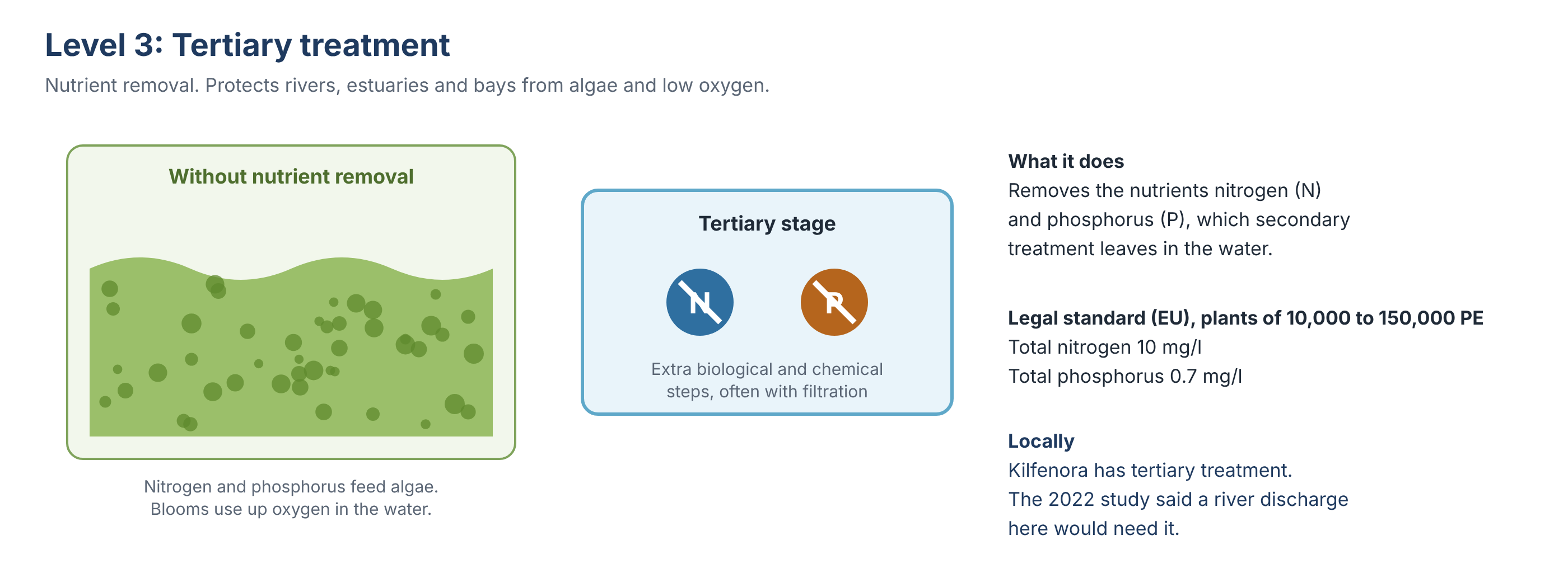
Secondary treatment leaves nutrients, mainly nitrogen and phosphorus, in the water. They act like fertiliser, feeding algae in rivers, estuaries and bays. When algae die and rot they use up the oxygen fish need. Tertiary treatment removes these nutrients. For plants of 10,000 to 150,000 PE, the EU standard is total nitrogen no more than 10 mg/l and total phosphorus no more than 0.7 mg/l.
Locally: Uisce Éireann’s 2022 feasibility study found that “tertiary treatment is required for any discharge to the River Inagh”. Its new plant at Kilfenora includes “tertiary filtration and UV disinfection”. We want the same standard considered for Lahinch and Ennistymon.
Sources: Directive (EU) 2024/3019, Article 2(13) and Annex I, Table 2; Mott MacDonald Feasibility Study Report (2022), section 5.10; Uisce Éireann, Kilfenora Wastewater Treatment Plant project page.
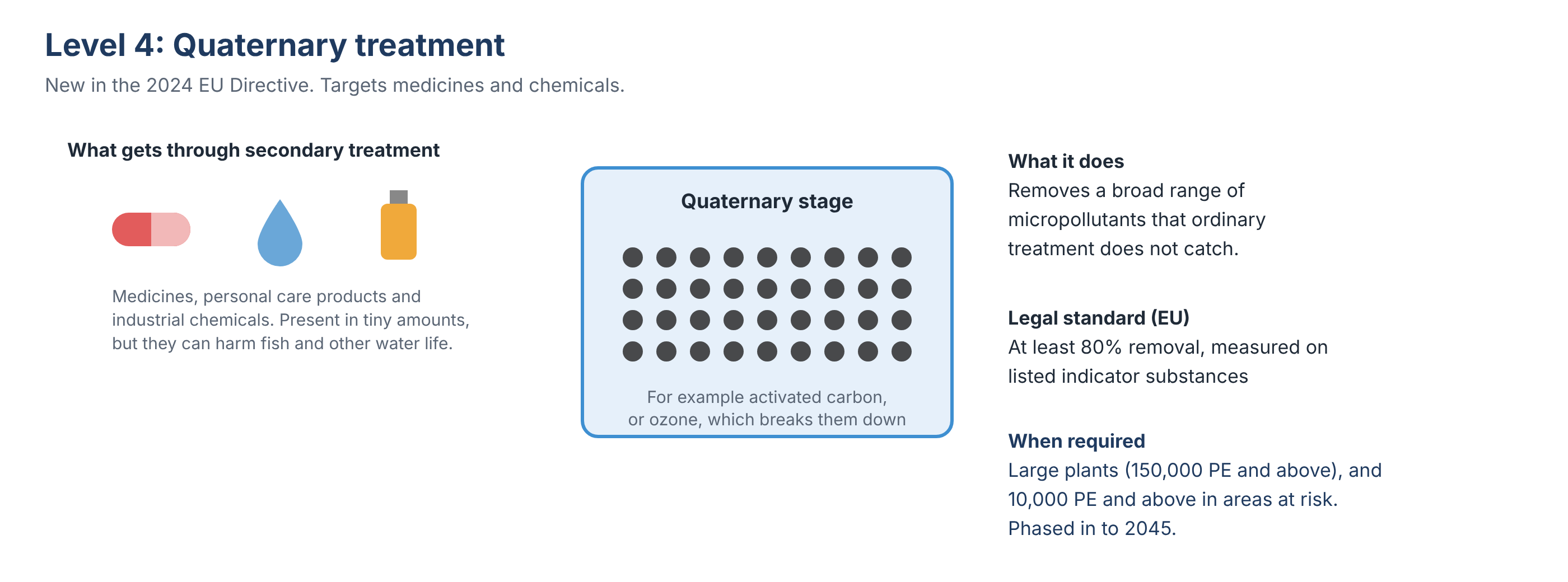
Level 4: Quaternary treatment
Traces of medicines, personal care products and industrial chemicals can pass through ordinary treatment. These micropollutants can harm fish and other water life, and EPA-funded research has found that conventional plants may not remove all active pharmaceutical ingredients. Quaternary treatment, new in the 2024 EU Directive, must remove at least 80% of a list of indicator substances, using methods such as activated carbon or ozone.
When it applies: to all plants of 150,000 PE and above, and to plants of 10,000 PE and above discharging into areas listed as at risk. The requirements are phased in between 2033 and 2045.
Sources: Directive (EU) 2024/3019, Article 2(14), Article 8 and Annex I, Table 3; EPA Research Report 475.
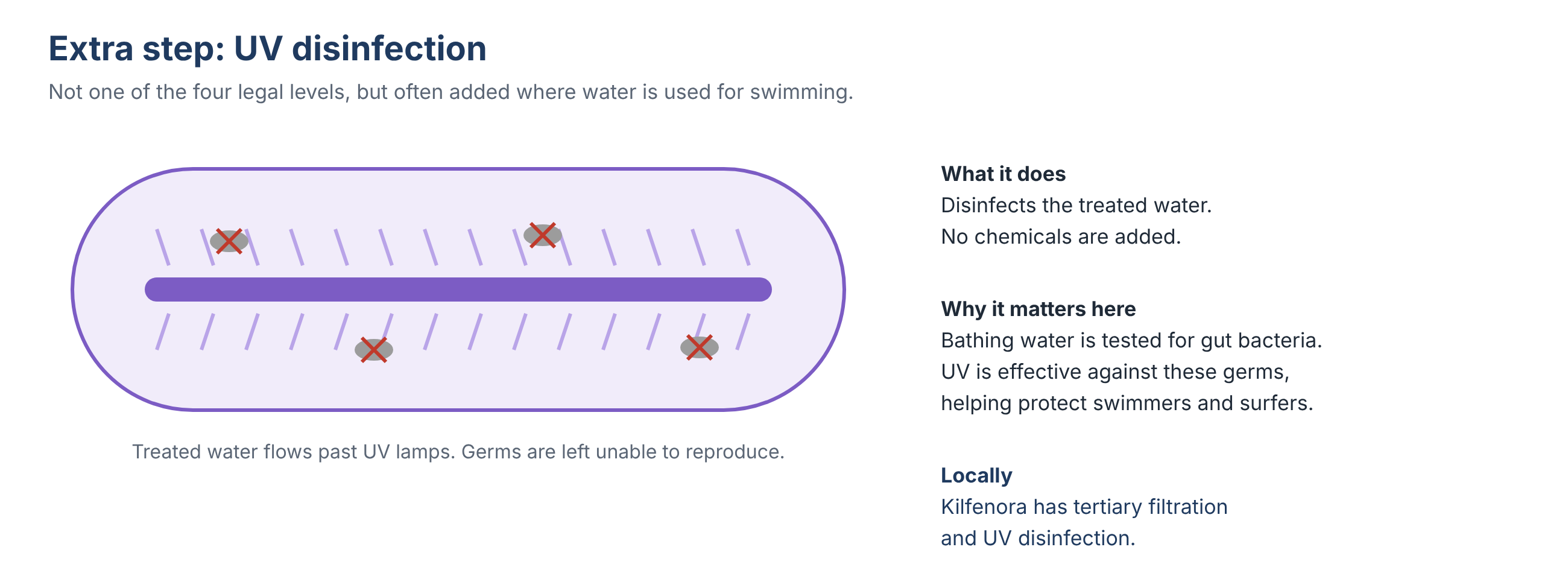
Extra step: UV disinfection
Treated water passes under ultraviolet lamps, which damage bacteria and viruses so they cannot reproduce. No chemicals are added. UV is not one of the four legal levels, but it matters here: bathing water is judged on two types of gut bacteria, E. coli and intestinal enterococci. Lahinch was rated “Good” for 2025, down from “Excellent”, and lost its Blue Flag for 2026.
Sources: Directive 2006/7/EC (Bathing Water Directive), Annex I; Clare FM, 13 May 2026; Uisce Éireann, Kilfenora project page.
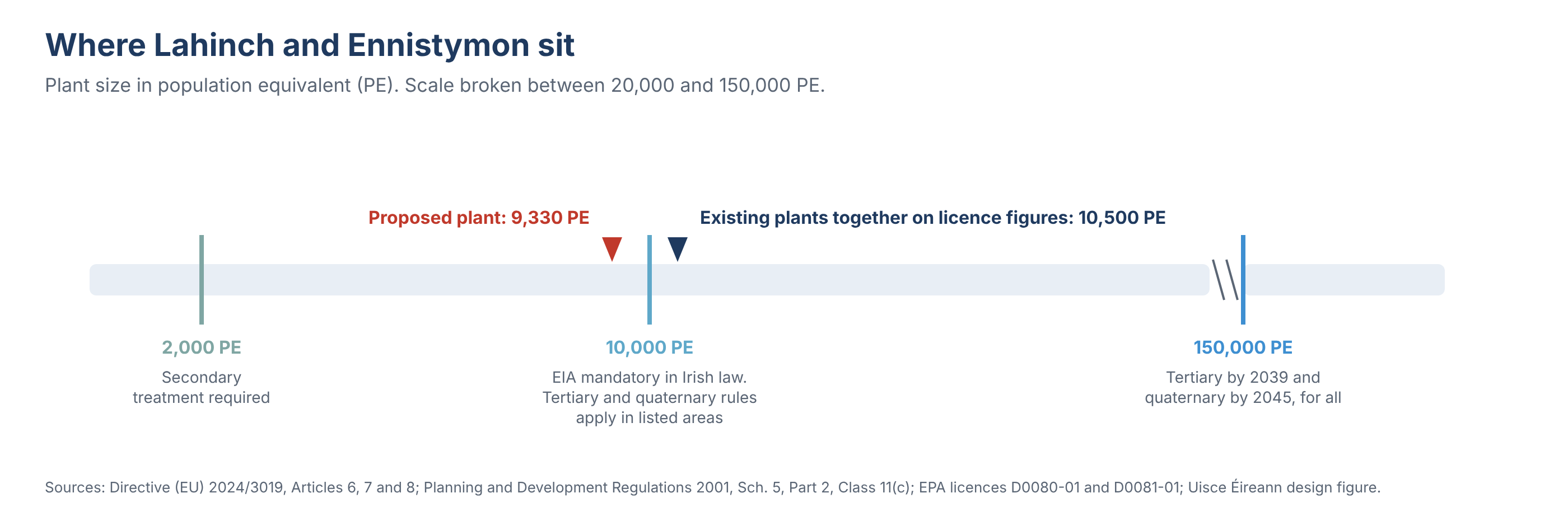
Where Lahinch and Ennistymon sit
The proposed plant is designed at 9,330 PE, just below 10,000 PE. At that size secondary treatment is required, but tertiary and quaternary treatment are not automatically required. Above 10,000 PE, an Environmental Impact Assessment becomes mandatory in Irish law, and EU tertiary and quaternary rules can apply where the receiving water is listed as sensitive or at risk. The two existing plants were rated at 10,500 PE together on their EPA licence figures.
Sources: Directive (EU) 2024/3019, Articles 6, 7 and 8; Planning and Development Regulations 2001, Schedule 5, Part 2, Class 11(c); EPA licences D0080-01 and D0081-01; Uisce Éireann pre-planning presentations (FOIR2198).
Our questions
What level of treatment is proposed, and will it include UV disinfection to protect bathing water?
Which treatment technologies were considered, and how did each compare on environmental performance?
How far, and how high, will wastewater be pumped from each town? What happens if pumps or power fail?
How will stormwater and groundwater entering the sewers be reduced, and how much storage is planned?
Where will emergency overflows be located, how often are they expected to operate, and how will the public be told?
How will odour be prevented and monitored?
Will the design be reviewed by independent experts, and will the reports be published in plain language as the design develops?
What we are asking for
A treatment process chosen on published evidence, independent technical review, and real engagement with the community at each stage, not only at the end.